
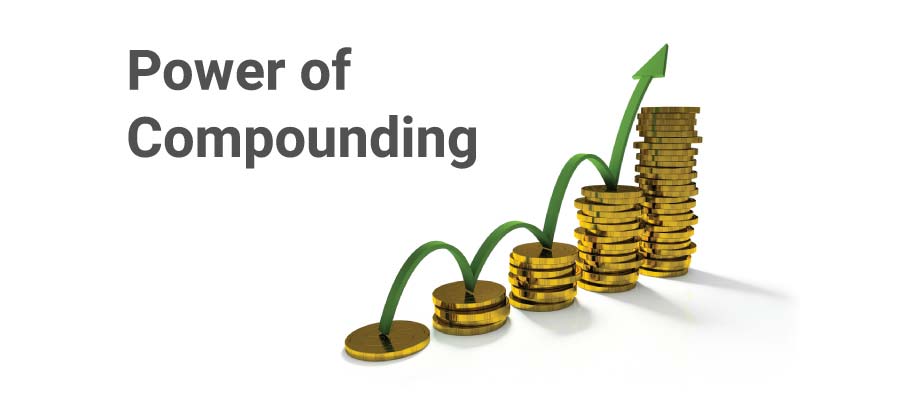
Power Of Compounding

The most powerful tool for creating wealth safely and surely is the magical “power of compoinding”. If you park your money in am investment with a given return, and then reinvest those earnings as you receive them, your investment grows exponentially over time. IIIustratively, if you set aside a sum of say 5000 every month form the age of 25, earning interest at the rate of 10 % per anum in 60 years you will have with you fund worth more than Rs. 1 crore. However, if u start at 40 with the same amount and rate of interest, the fund accumulated will amount to only around Rs. 33 lakh. Hence it is always advisable to start savings early to enjoy the benifits of power of compounding.

What Factors Determine Interest Rates ?

When we talk of interest rates, there are different types of interest rates -Rates that banks offer to their depositore, rates that they lend to their borroers, the rate at which the Government Securities market, rates offered to investors in small savings schemes like NSC ,PPF, rates at which companies issue fixed deposits etc.

The factors which govern these interest rates are mostly economy related and are commonly referred to as macroeconomic factors. Some of these factors are:

  1. Demand for money
  2. Level of Government borrowings
  3. Supply of money
  4. Inflation rate
  5. The Reserve Bank Of India and the Government policies which determine some of the variables mentioned above.

What is Meant by Interest ?

When we boroow money, we are expected to pay for using it – this is known as interest. Interest is an amount charged to the borrower for the privilege of using the lender’s money. Interest is usually calculated as a percentage of the principal balance (the amount of money borrowed). The percentage rate may be fixed foe the life of the loan, or it may be variable, depending on the terms of the loan. When we borrow money, we are expected to pay for using it – this is known as interest. interest is an amount charged to the borrower for the privilege of using the lender’s money . Interest is usually calculated as percentage of the principal balance ( the amount of money borrowed). The perecentage rate may be fixed for the life of the loan, or it may be variable , depending on the terms of the loan.

When to Start Investing ?

The sooner one starts investing the better. By investing early you allow your investments more time to grow, whereby the concept of compounding (as we shall see later) increases your income, by a cumulationg the principal and the interest or dividend earned on it, year after year. The three golden rules for all investors are:

  1. Invest Early
  2. Invest Regularly
  3. Invest for long term and not short term

Why Should one Invest ?

One needs to invest to ;-

  1. Earn returns on your idle resources.
  2. Generate a specified sum of money for a specific goal in life.
  3. Make a provision for an incertain future . One of the important reasons why one needs to invest wisely is to meet the cost of inflation. inflation is the rate of which the cost of living increases. The of living is simply what is costs to buy the goods and services you need live. inflation causes money to lose value because it will not buy the same amount of a good or a service in the future as it does now or did in the past . For example , if there was 6% inflation rate for the next 20 years, a Rs. 100 purchase today would cost Rs.321 in 20 years. This is why it is important to consider inflation as factorin any long term investment strategy. Remember to look at an investment’s “real” rate of return, which is the return after inflation . The aim of investments should be to provide a return above the inflation rate to ensure that the investment does not decrease in value. For example. if the annual inflation rate is 6%. then the investment will need to earn more than 6% to ensure it increases in value. if the after tax return on your investment is less than the inflation tare, then your assets have actually decreased in value that is , they won’t buy as much today as they did last year.